
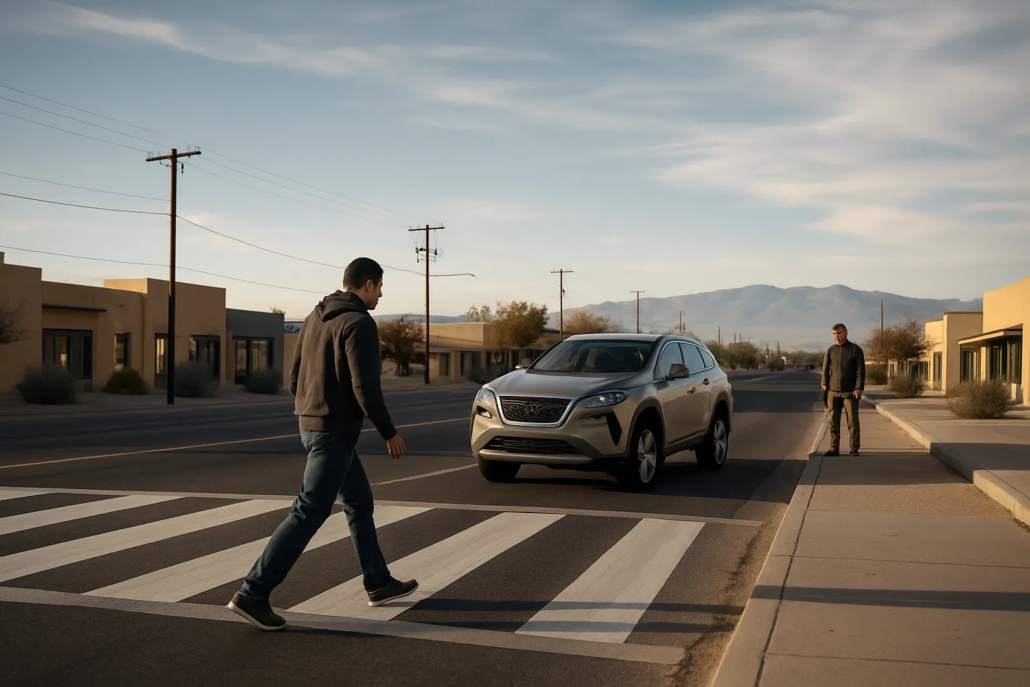
Which Proof Can an Albuquerque Lawyer Use for Pedestrians?
A pedestrian collision can leave a person dealing with pain, transportation problems, missed work, and uncertainty about what happened. If you are searching for an Albuquerque pedestrian accident lawyer after being hit, one of the first questions is often: who may be responsible, and what evidence can show it?
Responsibility is not always limited to the person behind the wheel. Depending on the facts, a claim may involve the driver, a vehicle owner or employer, a public roadway entity, a contractor, or more than one party. The Crecca Law Firm helps injured people understand the issues that may affect a pedestrian injury claim in Albuquerque. This article explains the immediate roadmap: medical care, scene evidence, witness information, visibility questions, insurance reporting, and documentation of mobility limitations. It also outlines how liability may be evaluated under New Mexico law, which can change and may apply differently depending on the circumstances.
Who May Be Responsible in an Albuquerque Pedestrian Accident?
A pedestrian crash investigation generally focuses on what each involved person or entity did—or failed to do—before the collision. A driver may be responsible if distraction, speeding, impairment, failure to yield, unsafe turning, or inadequate lookout contributed to the impact. A driver’s traffic citation may be relevant, but it is not necessarily the only evidence used in a civil claim.
Potential responsibility beyond the driver
Other possible sources of liability can include:
- The vehicle owner: An owner may have responsibilities separate from the driver, depending on how the vehicle was entrusted or used.
- An employer: If a worker was driving for job-related duties, the employer may become part of the liability analysis. The facts and legal relationship matter.
- A roadway or property entity: Poor lighting, a blocked sightline, a dangerous crossing design, or an unrepaired defect may raise questions involving the City of Albuquerque, Bernalillo County, the New Mexico Department of Transportation, or another responsible entity.
- A contractor or maintenance company: Construction, signal work, landscaping, or maintenance may affect whether a hazard was created or left unaddressed.
- A vehicle or parts manufacturer: In unusual cases, a defect affecting braking, visibility, or vehicle control may require a separate investigation.
These possibilities do not establish liability by themselves. An attorney may need to examine ownership records, employment details, roadway control, maintenance history, photographs, and witness accounts. In Albuquerque, determining who controlled an intersection or sidewalk can be important because responsibility may depend on the location and the type of roadway feature involved.
What Evidence Can Clarify a Pedestrian Hit by a Car in Albuquerque?
Evidence can disappear quickly. Vehicles are repaired, surveillance systems overwrite recordings, weather changes, and witnesses may become difficult to locate. A careful record of the scene and the injury’s effects can help preserve the facts for an insurance review or potential claim.
Immediately after the collision, emergency care and safety come first. When reasonably possible, useful information may include:
- Medical records and instructions. Keep records of emergency treatment, follow-up visits, prescriptions, referrals, and restrictions. Do not assume an injury is minor because symptoms develop later; medical professionals can evaluate symptoms and provide appropriate care.
- Scene photographs. Images may show the crosswalk, traffic signals, lane markings, lighting, vehicle position, weather, obstructions, and visible damage. Photos should be taken only when it is safe to do so.
- Witness information. Record names and reliable contact details for people who saw the impact, heard the signal, observed the driver’s approach, or saw conditions immediately afterward.
- Clothing and visibility information. Preserve the clothing and footwear worn at the time, without altering or washing items if they may help show visibility or contact. The relevant questions can include lighting, reflective material, weather, traffic conditions, and whether anything blocked the driver’s view.
- Mobility documentation. Note how the injury affects walking, standing, driving, stairs, work, household tasks, and transportation. A short daily log may help capture limitations that are hard to remember later.
A police report can provide useful facts, but it may not resolve every disputed issue. In a crosswalk accident claim in New Mexico, signal timing, right-of-way evidence, roadway design, and comparative-fault arguments may all require closer review. Avoid guessing about fault in recorded statements or social media posts. Insurance companies may request information, but the scope and wording of a response can affect how a claim is evaluated.
How Are Insurance, Fault, and Claim Decisions Evaluated?
Insurance reporting is often one of the first practical issues after a pedestrian collision. The driver’s liability coverage may be relevant, but other policies could also matter. For example, coverage questions may arise if the driver was working, the vehicle was borrowed, or the at-fault driver has limited or no insurance. An injured pedestrian may also have potential coverage under an applicable household policy, depending on the policy language and facts.
New Mexico generally follows a comparative-fault approach. In broad terms, an injured person’s conduct may be considered when assigning responsibility, and a recovery may be adjusted based on the percentage of fault assigned. The precise effect depends on the evidence, the parties, and the legal issues involved. Wearing dark clothing, crossing outside a marked crosswalk, or using a phone should not automatically end the analysis; the facts, visibility, traffic conditions, and each person’s conduct must be examined together.
Common claim issues include:
- whether the driver had a reasonable opportunity to see and avoid the pedestrian;
- whether a traffic signal, crosswalk, or intersection layout affected the collision;
- whether the pedestrian’s actions actually contributed to the impact;
- whether a roadway defect or obstruction created an independent hazard;
- whether the claimed injuries and mobility limitations are supported by medical documentation; and
- whether a public entity may be involved, which can create special notice, timing, or procedural requirements under New Mexico law.
A pedestrian injury compensation claim in Albuquerque may include categories such as medical expenses, lost income, reduced ability to work, and non-economic harm. The available damages depend on proof and the governing law. Claims against public entities can involve additional rules, so identifying the correct entity early may be important. Because New Mexico laws and procedures can change, a licensed attorney can assess the current requirements for the specific location and parties involved.
What Mistakes Can Weaken a Pedestrian Collision Claim?
People often focus on the vehicle and overlook evidence about the surrounding conditions. A complete investigation should consider the pedestrian’s route, the driver’s route, lighting, traffic signals, sightlines, weather, road design, and what happened in the seconds before impact.
Several avoidable problems can make a claim harder to evaluate:
- delaying medical evaluation or ignoring follow-up instructions;
- failing to preserve clothing, photographs, damaged personal items, or transportation records;
- assuming the police report is complete without checking for factual errors;
- giving a recorded insurance statement before understanding the questions;
- posting photographs or comments that do not show the full effect of the injury; and
- waiting too long to identify possible public entities, employers, witnesses, or surveillance sources.
A person who was hit by a car in Albuquerque may also have difficulty describing mobility restrictions while trying to keep working or managing family responsibilities. A simple record of missed shifts, altered duties, canceled activities, assistance from others, and transportation costs can provide helpful context. It should be factual rather than exaggerated.
When choosing an Albuquerque pedestrian accident lawyer, readers may ask whether the attorney can investigate roadway conditions, communicate with insurers, explain fee terms, and handle more than a basic driver-versus-pedestrian dispute. A consultation can help identify potential parties and explain which records may be relevant. No attorney can promise a particular result, and every claim depends on its own evidence.
Frequently Asked Questions
Does a pedestrian always have the right of way in Albuquerque?
No. Right-of-way questions depend on the location, traffic controls, pedestrian conduct, driver conduct, and surrounding facts. A marked crosswalk, traffic signal, or intersection may affect the analysis, but it does not automatically determine civil liability in every case. New Mexico comparative-fault principles may also matter if evidence suggests more than one person contributed to the collision. A fact-specific review is necessary.
Can I bring a claim if the driver left the scene?
A claim may still be possible, but identifying the driver and available insurance can be difficult. Helpful information may include witness accounts, nearby business or residential video, photographs, vehicle descriptions, and the police report. Depending on the applicable policy and facts, uninsured-motorist coverage may also become relevant. Reporting the collision and preserving evidence can assist an attorney in evaluating available options.
What if a defective sidewalk or signal contributed to the crash?
A roadway or sidewalk condition may raise a separate liability issue involving a public entity, contractor, or other responsible party. The controlling entity is not always obvious, particularly near highways, intersections, or property boundaries. Claims involving New Mexico public entities may have special notice and procedural requirements. Photographs, location details, maintenance information, and prompt legal review may help determine whether that theory is viable.
How long do I have to pursue a pedestrian injury claim in New Mexico?
Deadlines vary based on the legal theory, the parties, and whether a public entity is involved. Missing a limitation or notice deadline can affect the ability to pursue a claim. Because the applicable period may depend on facts that are not immediately apparent, an Albuquerque pedestrian accident lawyer can review the collision date, potential defendants, insurance issues, and current New Mexico requirements during a consultation.
How The Crecca Law Firm Can Help
The Crecca Law Firm is dedicated to helping injured pedestrians understand the facts and legal issues surrounding a collision. The firm can review available records, identify potential sources of responsibility, assess insurance questions, and consider how medical care and mobility limitations affect the claim. Its team is committed to fighting for clients’ rights while providing a clear explanation of the process and possible options. Contact The Crecca Law Firm for a free consultation or case evaluation regarding your Albuquerque pedestrian collision.
The information in this article is for educational purposes only and does not constitute legal advice. Contact a qualified attorney licensed in Albuquerque, NM for advice specific to your situation.



Leave a Reply
Want to join the discussion?Feel free to contribute!