
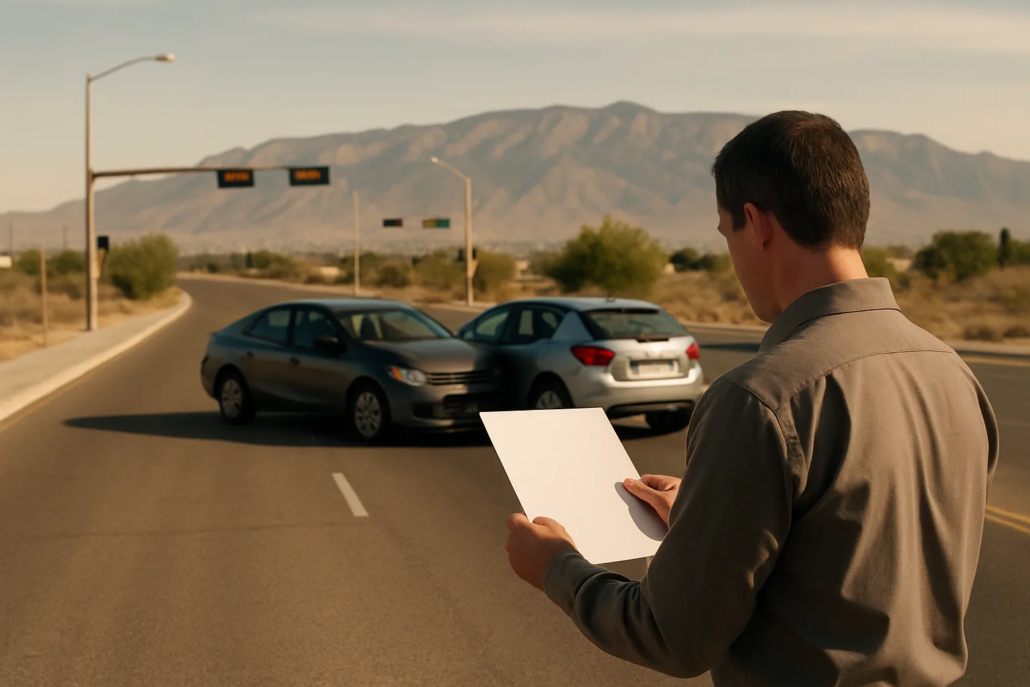
When Does an Albuquerque Crash Report Influence Fault?
After a collision, many drivers assume the police report settles the question of fault. But what happens when the report leaves out a witness, misunderstands the impact, or says you caused the accident even though other evidence points elsewhere? For someone searching whether an Albuquerque car accident police report decides fault, the short answer is usually no: the report may be important, but it is not automatically the final word in a civil claim. The Crecca Law Firm helps readers understand how to assess that evidence without treating an initial conclusion as a guaranteed determination.
This article explains what an officer’s report may show, how citations and statements can affect an insurance dispute, what to do if the report appears incomplete or inaccurate, and how to communicate with insurers when facts remain disputed.
For additional guidance, see fixing errors in an Albuquerque car accident police report.
Does an Albuquerque Police Report Decide Fault in a Car Accident?
A crash report is generally one piece of evidence among many. An officer may record statements from drivers and witnesses, note visible damage, prepare a diagram, document road conditions, and state an opinion about contributing factors. Those observations can be useful, particularly when the report was prepared soon after the collision.
However, an officer may not have seen the crash happen. The report may rely on brief interviews, limited physical evidence, or information available at the scene. A diagram may simplify lane positions or movement. A citation may indicate that an officer believed a traffic rule was violated, but a traffic citation and a civil car accident claim are not identical proceedings. The citation does not automatically establish every fact needed to resolve financial responsibility for injuries or property damage.
What information in a report may matter?
Review the report for:
- Each driver’s version of events and whether it is accurately recorded.
- Witness names, contact information, and descriptions of what they observed.
- Officer observations about damage, debris, skid marks, traffic controls, and road conditions.
- The diagram, measurements, narrative, and any listed contributing factors.
- Citations, statements about admissions, and references to video or other evidence.
A report that says a driver caused the crash may influence an adjuster, but insurers and courts may also consider photographs, vehicle damage, video, medical records, testimony, and other evidence. New Mexico rules concerning fault and evidence can be fact-specific and may change, so local legal review may be useful when the report conflicts with the rest of the record.
What Should You Do If an Albuquerque Accident Report Is Wrong?
Start by obtaining the complete report from the investigating agency, such as the Albuquerque Police Department when it handled the collision. Depending on where the crash occurred, another law-enforcement agency may have prepared it. Read the narrative, diagram, witness section, citation information, and any supplemental pages rather than relying only on an insurer’s summary.
If the report contains a factual error or omission, identify the issue precisely. Separate an objective mistake—such as an incorrect vehicle description or missing witness—from a disagreement with the officer’s interpretation. Ask the investigating agency whether it has a process for submitting additional information or requesting a supplemental report. A correction is not guaranteed, and an agency may not change an officer’s conclusion simply because a driver disagrees with it. More information about fixing errors in an Albuquerque car accident police report may help you understand the distinction.
Preserve independent proof before it disappears
A report can be supplemented by evidence created independently of the officer’s initial investigation. Consider preserving, when available and lawfully obtained:
- Photographs or video of vehicles, the roadway, traffic controls, lighting, and visible damage.
- Names and contact information for witnesses, along with notes about what each person personally observed.
- Dashcam, nearby business-camera, or residential-camera leads before recordings are overwritten.
- Repair estimates, inspection photographs, towing records, and contemporaneous notes about the collision.
- Phone or location information only through appropriate legal and privacy channels.
This is why preserving the strongest evidence after a car accident can matter when the report does not tell the full story.
How Evidence and Insurer Communications Can Challenge a Report
The strongest response to an unfavorable report is usually a clear, organized account supported by reliable evidence—not an exaggerated accusation that the officer acted improperly. Look for specific conflicts: a witness who describes a different light color, damage that appears inconsistent with the diagram, a camera that may show lane movement, or a statement that does not reflect what a driver remembers saying.
Intersection crashes in Albuquerque often require close attention to signal timing, sightlines, turning paths, lane position, and right-of-way facts. Conditions can change quickly after a collision, so preserving evidence from an Albuquerque intersection crash may help maintain details that a short diagram cannot capture.
Communicate carefully with an insurer
When an adjuster asks about the report, provide accurate firsthand facts and distinguish memory from assumption. Avoid adopting a disputed conclusion merely because it appears in the report. It is also unwise to guess about speed, distance, signal timing, or another driver’s actions.
Before giving a recorded statement, consider preparing for an Albuquerque recorded insurance statement. If a question is unclear or assumes a fact you dispute, ask for clarification. These questions to clarify before answering an Albuquerque crash adjuster can help a driver understand what information is being requested without overstating uncertain facts.
A driver should also avoid deleting messages, altering photographs, repairing or disposing of a vehicle before documenting its condition, or posting a speculative account publicly. If the report, evidence, and insurer’s position conflict, an attorney may assess how New Mexico’s fault principles and available proof apply to the particular claim.
Frequently Asked Questions
Can an officer’s opinion in a crash report be challenged?
Yes, an officer’s opinion may be challenged with evidence that provides a different account, such as witness testimony, photographs, video, vehicle damage, or additional records. Challenging an opinion does not necessarily mean the report will be rewritten. The practical question is how the complete evidence affects an insurer’s evaluation or a later civil proceeding. The relevance and weight of each item depend on the circumstances and applicable New Mexico law.
What if the police report leaves out my witness?
Obtain the report and check whether the witness was listed under another name or in a supplemental page. Preserve the witness’s contact information and ask what the witness personally saw, rather than coaching the person about fault. You may provide the information to the investigating agency or insurer, depending on the situation. An attorney can explain how witness evidence may be documented and used in a disputed Albuquerque claim.
Does a traffic citation prove civil liability for the crash?
Not automatically. A citation may be relevant because it reflects an officer’s belief that a traffic rule was violated, but a civil claim can involve additional questions about causation, damages, and the conduct of other people. The effect of a citation may depend on the underlying facts and applicable New Mexico procedures. Readers should avoid assuming that paying, contesting, or receiving a citation alone resolves the civil claim.
Should I tell the insurer that I disagree with the report?
You can accurately explain that the report does not reflect your account, but avoid presenting uncertain facts as established or making statements about matters you did not personally observe. Keep communications factual and preserve supporting evidence. If an insurer requests a recorded statement or relies heavily on an unfavorable report, Albuquerque auto accident lawyers who can evaluate disputed fault may be able to review the situation and discuss available options.
How The Crecca Law Firm Can Help
The Crecca Law Firm is dedicated to helping Albuquerque crash victims understand how police reports, citations, witness accounts, physical evidence, and insurance communications may affect a claim. The firm can review whether an accident report appears incomplete, organize evidence that may support a different account, and help evaluate disputed fault under applicable New Mexico principles. Each case depends on its specific facts, and no legal review guarantees a particular result.
If a report appears inaccurate or an insurer is relying on it to question your claim, contact The Crecca Law Firm for a free consultation or case evaluation. The team is committed to fighting for your rights and is ready to evaluate your situation.
The information in this article is for educational purposes only and does not constitute legal advice. Contact a qualified attorney licensed in Albuquerque for advice specific to your situation.



Leave a Reply
Want to join the discussion?Feel free to contribute!