The Crecca Law Firm
  • Home
  • About Us
  • Practice Areas
    • Asbestos Cases
    • Bad Faith Insurance
    • Bicycle Accidents
    • Brain and Head Injuries
    • Burn Injuries
    • Business Litigation
    • Car Accident
    • Medication & Drug Liability
    • Dog Bite
    • Drunk Driving Accidents
    • Motorcycle Accidents
    • Nursing Home Negligence
    • Pedestrian Injuries
    • Personal Injury
    • Slip & Fall Accidents
    • Trucking Accidents
    • Uninsured Motorist
    • Wrongful Death
  • Blog
  • News
  • Contact Us
  • (505) 766-9999
  • Menu Menu
12 Best Questions for an Injury Consultation

12 Best Questions for an Injury Consultation

August 4, 2026

An insurance adjuster may call while you are still in pain, missing work, and trying to understand what happened. That is not the time to guess whether a lawyer is ready to protect you. The best questions for injury consultation help you see past advertising and find out whether an attorney has the experience, attention, and fight your case demands.

A free consultation is your opportunity to take control before an insurance company controls the story. You do not need to know every legal term. You need honest answers about your rights, the strength of your claim, and what the law firm will actually do when the pressure starts.

Your Consultation Should Be a Real Case Evaluation

A serious injury case is not just an insurance claim. It can involve medical treatment, lost income, future care, family strain, damaged evidence, and a defendant determined to pay as little as possible. The lawyer you choose should listen closely, ask hard questions, and explain the path ahead without making empty promises.

Pay attention to more than the answers. Notice whether you speak with an attorney, whether they understand the facts that make your case different, and whether they are willing to discuss the difficult parts. A lawyer who promises a fast, guaranteed payout before reviewing the evidence is selling confidence, not counsel.

Best Questions for an Injury Consultation

1. Have you handled cases like mine?

Ask about the specific kind of injury and accident involved. A car crash, commercial truck collision, nursing home neglect claim, wrongful death case, and insurance bad faith dispute can require very different evidence and legal strategies.

A qualified attorney should be able to explain what makes cases like yours challenging. For example, a truck crash may require quick action to preserve driver logs and company records. A brain injury claim may require detailed medical proof of symptoms that are not visible on an X-ray.

2. Who may be legally responsible for my injuries?

The person who caused the immediate harm is not always the only responsible party. An employer, vehicle owner, property owner, business, nursing home, manufacturer, or insurer may also have responsibility depending on the facts.

Ask the attorney who they would investigate and why. A thorough answer shows that the firm is looking beyond the obvious target and considering every source of accountability and available insurance coverage.

3. What evidence needs to be protected right now?

This question can change the direction of a claim. Video footage can be erased. Vehicles can be repaired or destroyed. Witness memories fade. In some cases, businesses and insurance carriers have records that are much easier to obtain before too much time passes.

Ask whether the firm will move quickly to preserve evidence. You should also ask what you can do immediately, such as saving photos, keeping damaged property, tracking symptoms, and avoiding posts about the accident on social media.

4. What is my case worth, and what information is still missing?

No honest lawyer can put a precise value on a serious injury case during the first conversation. Your medical condition may still be changing, and the full impact on your work and daily life may not yet be clear.

Still, the attorney should explain the categories of damages that may apply. These can include medical bills, lost wages, reduced earning ability, pain and suffering, property damage, and, in the most devastating cases, wrongful death damages. Ask what facts could increase or limit the value of your claim.

5. Will I speak directly with the attorney handling my case?

You deserve to know whether your case will be handed off after the intake call. Support staff can play an essential role, but a serious injury claim requires attorney involvement, strategic judgment, and direct communication when important decisions arise.

Ask who will return your calls, who will prepare you for major steps, and how often you can expect updates. Clear communication is not a luxury when your health, income, and future are on the line.

6. How do your fees and case costs work?

Most personal injury firms work on a contingency fee, meaning the attorney fee is paid from a recovery rather than from money you pay upfront. But you should ask for a plain-language explanation of the agreement before signing anything.

Find out how case expenses are handled, what happens if there is no recovery, and whether you may be responsible for any costs. A law firm that respects its clients will answer directly and put the terms in writing.

7. What should I do about calls from the insurance company?

Insurance adjusters are trained to protect the insurer’s bottom line. They may sound concerned, but they are also listening for statements that can be used to reduce or deny your claim. A recorded statement, early settlement offer, or broad medical authorization can create problems before you know what your case is worth.

Ask whether the law firm will take over communications with insurers. You should know what to say if an adjuster calls before you hire counsel and what documents you should not sign without legal advice.

8. Are there deadlines that could hurt my claim?

New Mexico law places deadlines on injury claims, and the right deadline depends on the type of case and the parties involved. Claims involving government entities, for example, may have notice requirements that arrive far sooner than many people expect.

Ask what deadlines apply to your situation and what must happen before those dates. Waiting too long can give a negligent driver, corporation, or insurer an advantage they did not earn.

9. What problems do you see in my case?

This is one of the most revealing questions you can ask. Maybe the other side will dispute fault. Maybe there was a gap in medical treatment, a preexisting injury, no independent witnesses, or limited insurance coverage. The right attorney does not hide these issues.

Ask how the firm would address the weaknesses. A case does not have to be perfect to be worth pursuing, but you need a lawyer who sees the defense coming and prepares for it early.

10. Will you prepare my case for trial?

Most injury cases resolve without a jury trial, but that does not mean trial preparation is optional. Insurance companies evaluate risk. They are more likely to take a claim seriously when they know the injured person has a lawyer willing and able to prove the case in court.

Ask about the firm’s trial experience and how it prepares claims before settlement negotiations begin. The question is not whether anyone can send a demand letter. The question is whether your lawyer can apply real pressure when the insurer refuses to be fair.

11. What medical care and records will matter most?

Your health comes first, and treatment also creates the medical record that demonstrates what the injury has cost you. Ask which providers, specialists, diagnostic tests, and future-care recommendations may be important to document.

A good attorney will not tell you to exaggerate symptoms or seek care you do not need. They should encourage you to follow appropriate medical advice and make sure the full impact of your condition is not minimized by an insurer.

12. What happens after I hire you?

Ask for a practical roadmap. The answer should cover the early investigation, insurance notifications, medical record collection, claim evaluation, settlement negotiations, and the possibility of filing a lawsuit if the other side will not accept responsibility.

You should leave the consultation knowing the next step and who is responsible for it. Uncertainty is hard enough after an injury. Your legal team should not add to it.

Warning Signs During an Injury Consultation

Be careful if a firm pressures you to sign immediately without answering your questions. Be equally cautious when someone guarantees a dollar amount, brushes off your medical concerns, or treats your case like a number in a high-volume system.

A lawyer may decide a case is not the right fit, and that can be an honest assessment. But you deserve an explanation, respect, and enough information to make an informed decision. You also deserve to know whether the firm has the resources to stand up to a large insurer, corporation, or defense law firm.

Bring What You Have, Not What You Think You Need

Do not delay a consultation because you do not have every document organized. Bring or share what is available: accident reports, photos, insurance letters, medical paperwork, contact information for witnesses, and any messages from the other side. Even a simple timeline of what happened and how your injuries have affected your life can help.

The strongest cases are often built early, before evidence disappears and before an insurer shapes the narrative. Ask direct questions, expect direct answers, and choose counsel prepared to fight for the full value of what was taken from you.


https://thecreccalawfirm.com/wp-content/uploads/2026/08/12-best-questions-for-an-injury-consultation-featured.webp 1024 1536 Attydamg2027 https://thecreccalawfirm.com/wp-content/uploads/2023/03/logo-300x87.png Attydamg20272026-08-04 19:15:342026-08-04 19:15:3512 Best Questions for an Injury Consultation
What an Asbestos Lawsuit Timeline Looks Like

What an Asbestos Lawsuit Timeline Looks Like

August 3, 2026

A mesothelioma or asbestos-related disease diagnosis can turn a family’s life upside down in a single appointment. Then comes the pressure: medical decisions, lost income, unanswered questions about where the exposure happened, and a concern that time is running out. An asbestos lawsuit timeline is not identical in every case, but understanding the major stages can help you protect your right to demand accountability from the companies that put profits ahead of people.

The most urgent point is simple: do not wait for a company, insurer, or former employer to tell you whether you have a claim. The evidence and legal deadlines can become harder to deal with as time passes. An experienced asbestos attorney can investigate the exposure history while your family focuses on treatment and care.

The First Weeks: Diagnosis, Records, and Legal Review

An asbestos case often begins after a diagnosis of mesothelioma, asbestosis, lung cancer, or another illness connected to asbestos exposure. A diagnosis alone does not automatically establish legal responsibility. The case must connect the illness to asbestos-containing products, workplaces, job sites, or companies that exposed the person to danger.

During an initial case review, an attorney will want to understand the person’s work history, military service, trades, employers, and possible secondary exposure. Secondary exposure can happen when a worker unknowingly carried asbestos dust home on clothing, shoes, or equipment, exposing a spouse or family member.

This stage also involves gathering medical records, pathology reports, imaging, employment information, union records, Social Security work history, and any documents that identify product manufacturers or job sites. Families often worry they need every record before speaking with a lawyer. They do not. The point of hiring counsel is to put an investigation behind the claim instead of making a sick person or grieving family do the detective work alone.

Why the Asbestos Lawsuit Timeline Starts With Deadlines

Asbestos illnesses can take decades to develop. Someone may have been exposed in a refinery, construction site, shipyard, power plant, military installation, or manufacturing facility 30 or 40 years ago. That long delay does not necessarily prevent a claim, but it makes legal timing especially important.

Each state has statutes of limitations, which are laws setting deadlines for filing a lawsuit. In many asbestos cases, the clock may be tied to the date a person discovered, or reasonably should have discovered, that an illness could be related to asbestos. Wrongful death claims can have separate deadlines that begin after a loved one dies.

The right deadline depends on the facts, the state where a case is filed, where exposure occurred, and the legal theories involved. Do not assume a claim is too old because the exposure happened long ago. At the same time, do not assume there is plenty of time because symptoms appeared recently. A lawyer should assess the deadline promptly.

Investigation and Filing the Lawsuit

Once the legal team has enough information to identify responsible parties, it can prepare and file a complaint. The complaint explains who was harmed, how asbestos exposure allegedly occurred, the medical condition involved, and why the defendants should be held liable.

Many people were exposed to asbestos through products made or supplied by more than one company. A single case may involve manufacturers, distributors, contractors, premises owners, or employers, depending on the circumstances. Some of those companies may have gone out of business, merged, or entered bankruptcy. That complexity is one reason asbestos litigation demands more than a quick review of a few old employment records.

After filing, each defendant must be formally notified and given an opportunity to respond. Their response is rarely an admission of fault. Powerful corporations and their lawyers commonly deny responsibility, challenge the exposure evidence, point fingers at other companies, or argue that another cause led to the illness. That is not a reason to back down. It is the predictable defense playbook.

Discovery: Building the Proof

Discovery is the phase in which both sides exchange information and take testimony. It is often the longest part of an asbestos lawsuit timeline, though courts may move quickly when a claimant is seriously ill.

The plaintiff’s legal team may seek corporate documents, product records, safety information, prior testimony, insurance materials, and evidence of what a company knew about asbestos hazards. Former coworkers, family members, medical experts, industrial hygienists, and product-identification witnesses may also provide important evidence.

The injured person may give a deposition, which is sworn testimony taken outside the courtroom. This can feel intimidating, particularly for someone undergoing treatment. A prepared legal team makes a difference. The testimony is not about performing for the other side. It is about preserving the truth: where the person worked, what materials they handled, what warnings were missing, and how the illness has changed daily life.

In some cases, the court may schedule an early deposition so testimony is preserved. That step can be vital when a disease is aggressive or a claimant’s health is declining.

Settlement Talks Can Happen at Any Stage

A case does not need to reach a jury trial before settlement discussions begin. Defendants may evaluate settlement after reviewing the complaint, after key depositions, near trial, or even during trial. The timing depends on the strength of evidence, the number of defendants, the medical proof, applicable law, insurance coverage, and each company’s willingness to accept responsibility.

A settlement can provide needed financial support without the uncertainty and strain of a trial. But a fast offer is not automatically a fair offer. Insurance companies and corporate defendants know that families facing medical bills and grief may feel pressured to accept less than the full value of a claim.

A trial-ready lawyer evaluates settlement offers against the actual evidence and losses, not against what is easiest for the defense. That includes medical expenses, lost wages, reduced earning capacity, pain and suffering, loss of companionship, and, when supported by the facts and law, other damages. Every case is different, and no lawyer should promise a particular result. But families deserve counsel willing to say no when a defendant tries to buy its way out of accountability on the cheap.

Bankruptcy Trust Claims May Follow a Different Track

A number of asbestos companies filed for bankruptcy and established trust funds to compensate people harmed by their products. A trust claim is separate from a lawsuit against solvent companies, although the two can overlap.

Trust claims have their own procedures, medical requirements, exposure criteria, and payment schedules. They may move faster than a civil lawsuit, but they still require careful documentation. Filing a trust claim without understanding its effect on other claims can create avoidable problems. A coordinated strategy matters.

How Long Does an Asbestos Case Take?

There is no honest one-size-fits-all answer. Some claims resolve in months, particularly when the evidence is well documented and a defendant is prepared to negotiate. Others take a year or longer because of disputed exposure history, multiple defendants, bankruptcy issues, court scheduling, or a defendant that refuses to deal fairly.

The goal is not to drag a case out. The goal is to move it with urgency while building proof strong enough to withstand the attacks defendants will make. Rushing a case before the evidence is ready can leave money and accountability on the table. Waiting without a reason can harm a family that needs answers now. Strong representation means knowing the difference.

What Families Can Do Right Now

Preserve what you have. Keep medical records, employment documents, old photographs from job sites, union information, military paperwork, and names of coworkers who may remember the work. Write down a work and exposure history while details are still clear. Include job titles, locations, dates, equipment, insulation, pipe covering, boilers, brake work, construction materials, and any visible dust or lack of warnings.

Do not let uncertainty stop you from getting answers. You may not know the name of every product or company today. That is common. The people responsible should not get a free pass simply because they concealed dangers, changed corporate names, or waited decades for the harm to surface.

If asbestos exposure or an asbestos-related diagnosis has affected your family, act before a legal deadline or missing evidence makes the fight harder. The Crecca Law Firm can evaluate the facts, explain the path forward, and stand up to the companies that would rather deny than pay for the damage they caused.

https://thecreccalawfirm.com/wp-content/uploads/2026/08/what-an-asbestos-lawsuit-timeline-looks-like-featured.webp 1024 1536 Attydamg2027 https://thecreccalawfirm.com/wp-content/uploads/2023/03/logo-300x87.png Attydamg20272026-08-03 19:15:512026-08-03 19:15:51What an Asbestos Lawsuit Timeline Looks Like
Best Questions for a Trial Lawyer Before Hiring

Best Questions for a Trial Lawyer Before Hiring

August 2, 2026

After a serious crash, a wrongful death, or an insurance denial, the other side may move fast. Adjusters call. Medical bills stack up. Someone may pressure you to give a recorded statement or accept a quick check before you know the full cost of your injuries.

The best questions for a trial lawyer help you separate a firm that takes cases from a lawyer prepared to fight for your future. You are not looking for polished promises. You are looking for direct answers about experience, strategy, communication, and whether the lawyer in front of you is ready to stand up to an insurance company when it refuses to be fair.

A consultation is your chance to ask. It is also the lawyer’s chance to show you how they handle pressure.

Why These Questions Matter After an Injury

Insurance companies know which lawyers prepare cases for trial and which ones are likely to settle fast. That difference can affect how seriously an insurer evaluates a claim. A trial-ready lawyer does not need to try every case, but the defense must believe the lawyer can and will take the case to a jury if a fair resolution is not offered.

No lawyer can honestly guarantee a dollar amount or promise a result. The facts, available insurance coverage, medical evidence, and New Mexico law all matter. But a good lawyer should be able to explain the risks, the next steps, and what they will do to protect evidence and build leverage.

12 Best Questions for a Trial Lawyer

1. Have you actually tried cases like mine to a jury?

This is one of the most important questions to ask. “Trial lawyer” is not just a title. Ask whether the attorney has tried personal injury or wrongful death cases, not merely handled settlements. If your case involves a commercial truck, a drunk driver, nursing home neglect, a dangerous product, or catastrophic injury, ask about experience with those specific claims.

You do not need identical facts. You need proof that your lawyer understands how to present difficult damages, challenge defense experts, and make a clear case to jurors.

2. Will you personally handle my case?

Many injured people hire a firm after speaking to an experienced lawyer, then spend the rest of the case dealing with staff members they have never met. Support staff can be valuable, but you deserve to know who is responsible for the strategy and who will answer hard questions.

Ask who will be your main point of contact, how often you can expect updates, and whether the attorney you meet will be involved if the case heads toward trial. Direct attorney access is not a luxury when your health, income, and family are on the line.

3. What do you see as the strongest and weakest parts of my case?

Be cautious if a lawyer tells you everything is perfect before reviewing records, evidence, and insurance information. Serious lawyers identify both opportunity and risk.

Maybe the other driver clearly caused the crash, but there is a dispute over whether treatment was necessary. Maybe liability is contested, but there is powerful evidence of lost earning capacity. An honest assessment helps you make decisions with your eyes open. It also tells you whether the lawyer is preparing for the arguments the defense will make, rather than only repeating the facts you already know.

4. What evidence needs to be protected right now?

Evidence can disappear quickly. Vehicle data may be lost, surveillance footage may be erased, witnesses can become difficult to locate, and a trucking company may control records that reveal how a collision happened.

Ask what the lawyer plans to do immediately. In some cases, that may include sending preservation letters, photographing a scene, locating witnesses, securing police records, or investigating potential corporate responsibility. Early action is especially important when a powerful defendant controls key evidence.

5. How will you deal with the insurance company?

The insurer is not calling to protect you. Its job is to limit what it pays, even when the policyholder caused devastating harm. Ask whether the firm will take over communications, handle requests for statements, and protect you from tactics designed to minimize your injury.

You should also ask how the lawyer evaluates an insurer’s offer. A number by itself means little. A fair evaluation considers medical care already received, future treatment, pain and suffering, lost wages, reduced ability to work, and the ways an injury has changed daily life.

6. Do you have the resources to take this case all the way?

Major injury cases can be expensive to prove. They may require accident reconstruction, medical specialists, life-care planners, economists, investigators, and extensive document review. A lawyer who lacks the resources or willingness to invest in the case may have less leverage against a well-funded insurer or corporation.

Ask how case expenses work and whether you owe anything if there is no recovery. You should receive a plain-language explanation of the contingency fee agreement before you sign it.

7. How do you determine what my claim may be worth?

A trustworthy answer will not be a quick estimate pulled from the air. The lawyer should explain that value depends on evidence, the severity and permanence of harm, liability, coverage, the defendant’s conduct, and how the injury affects your work and family.

In New Mexico, insurance limits can create a painful practical limit in some cases, even when the harm is severe. That is why a thorough lawyer investigates every possible source of recovery, including uninsured or underinsured motorist coverage when it applies.

8. What happens if I need more medical treatment?

Your legal claim should not force medical decisions. Your treatment should be directed by your medical providers and your health needs. Still, your lawyer needs to understand the diagnosis, treatment plan, future recommendations, and whether your injuries could have lasting consequences.

Ask how the firm will document future care and whether it will obtain the records and expert support needed to show the full impact of your injuries. Settling before the medical picture is clear can leave an injured person paying future costs alone.

9. How often will I hear from you, and how quickly do you return calls?

This question is simple, but the answer reveals a lot. You should not have to chase your own lawyer for months while bills and uncertainty pile up.

Ask how updates are delivered, who returns messages, and what happens when an urgent issue comes up. The Crecca Law Firm believes clients deserve straight answers and real access to the people fighting for them. Any firm you hire should make communication a commitment, not an afterthought.

10. What will you need from me?

A strong claim is a partnership. Your lawyer may need photographs, contact information for witnesses, medical provider details, employment records, insurance policies, and copies of bills or letters from insurers.

Ask what you should avoid doing, too. Posting about the accident or your activities on social media can be used against you. So can ignoring medical advice, missing appointments without explanation, or speaking casually with an adjuster about fault or symptoms.

11. How long could my case take?

No lawyer can give an exact timeline at the first meeting. Some claims resolve in months; others require litigation and can take much longer. The right answer is not the fastest one. It is the one that accounts for your medical condition, the investigation, the defendant’s conduct, and whether the insurer is willing to negotiate honestly.

Ask what milestones to expect: investigation, demand, filing suit if necessary, discovery, mediation, and trial preparation. A clear roadmap makes a difficult process less frightening.

12. Are you willing to go to trial if the offer is unfair?

This is the question that brings the others together. Ask it directly, then listen carefully. A lawyer should explain that trial has risks, costs, and no guaranteed outcome. But they should also make clear that they will not let an insurance company dictate the value of a serious injury simply because fighting is harder.

Trial readiness changes the conversation. When the other side knows your lawyer has prepared the evidence, understands the damages, and is ready to put the case before a jury, it has a reason to take your claim seriously.

Pay Attention to How the Lawyer Answers

The answer matters, but so does the manner. Are you being rushed? Does the lawyer listen without interrupting? Do they explain legal issues in plain English? Are they honest about uncertainty, or do they make big promises without reviewing the facts?

The right lawyer will not treat you like a file number or a quick settlement opportunity. They will take the time to understand what happened, what you have lost, and what it will take to hold the responsible party accountable.

You have already been through enough. Before you trust someone with your case, ask the hard questions and expect clear answers. A lawyer who is ready to fight for you will not be afraid of either.

https://thecreccalawfirm.com/wp-content/uploads/2026/08/best-questions-for-a-trial-lawyer-before-hiring-featured.webp 1024 1536 Attydamg2027 https://thecreccalawfirm.com/wp-content/uploads/2023/03/logo-300x87.png Attydamg20272026-08-02 19:18:222026-08-02 19:18:22Best Questions for a Trial Lawyer Before Hiring
Nursing Home Arbitration vs Court Explained

Nursing Home Arbitration vs Court Explained

August 1, 2026

A nursing home may hand you a thick admissions packet when your family is scared, exhausted, and trying to get a loved one settled into care. Buried in that paperwork may be an arbitration agreement. It can look routine. It is not. Nursing home arbitration vs court can determine who hears your case, what evidence you can obtain, whether the public can see what happened, and how much pressure the facility faces to make things right.

When neglect, abuse, falls, medication errors, bedsores, dehydration, or wrongful death occur, the nursing home and its insurer may have every reason to keep the dispute out of a courtroom. Your family has every reason to understand what that choice means before signing anything or accepting the facility’s version of events.

What Is Nursing Home Arbitration?

Arbitration is a private process for resolving a legal dispute outside the traditional court system. Rather than presenting the case to a judge and jury, both sides submit it to a neutral third party called an arbitrator. The arbitrator reviews evidence, hears arguments, and usually issues a binding decision.

Many nursing home arbitration agreements are presented at admission. Some say the resident or family member agrees to arbitrate any future dispute, including claims for negligence, neglect, abuse, or wrongful death. The agreement may be a separate form, or it may be tucked among pages dealing with billing, privacy, and facility policies.

The facility may describe arbitration as faster, simpler, and less expensive. Sometimes it can be faster. But speed is not the only measure of fairness. A family should ask whether the process gives them a real chance to expose unsafe staffing, ignored warning signs, altered records, or a corporate pattern of putting profits ahead of resident safety.

Nursing Home Arbitration vs Court: The Real Differences

The difference is not merely procedural. It changes the balance of power between an injured resident’s family and a corporate care provider.

Who decides the case

In court, a judge oversees legal issues, and a jury of community members may decide whether the nursing home was negligent and what damages should be awarded. A jury can hear the human story behind a chart entry: the call light that went unanswered, the infection that worsened, the fall that should have been prevented, or the family member who repeatedly begged staff for help.

In arbitration, a professional arbitrator usually decides the dispute. Arbitrators can be experienced and conscientious, but there is no jury. The process is private, and families may reasonably question whether a repeat-player facility or its insurer holds an advantage in a system the company uses again and again.

Access to evidence

Nursing home negligence cases are often won or lost on evidence the facility controls. Staffing schedules, incident reports, care plans, medication administration records, surveillance footage, training documents, internal emails, and prior complaints can reveal what really happened.

Courts generally provide formal discovery tools that allow both sides to demand documents, question witnesses under oath, and seek accountability when evidence is withheld. Arbitration may allow discovery too, but the scope can be more limited depending on the agreement and the arbitrator’s rules. That limitation matters when a family is trying to prove that what happened was not an isolated mistake.

Privacy and public accountability

Court filings and trials are generally part of the public record, subject to appropriate protections for sensitive information. Public proceedings can expose dangerous practices and force a facility to answer hard questions in the open.

Arbitration is usually confidential. Privacy can appeal to some families, particularly when they want to avoid public discussion of a loved one’s medical condition. But confidentiality can also protect a nursing home from public scrutiny. If a facility repeatedly harms residents, private resolutions may keep other families from learning about the pattern.

Appeals and finality

A court judgment can often be appealed if a serious legal error occurred. Arbitration decisions are much harder to challenge. In most situations, a court will not overturn an arbitrator simply because the family believes the arbitrator got the facts or law wrong. The grounds for setting aside an award are narrow.

That finality may reduce delay, but it also raises the stakes. If the process goes badly, there may be little opportunity to correct the outcome.

Cost and timing

Arbitration is often promoted as less expensive and quicker than litigation. That can be true in a straightforward case, but it is not guaranteed. Arbitration forums may charge filing and arbitrator fees, and disputes over the agreement itself can create delay before the underlying negligence claim is even heard.

A court case can take time, especially when the nursing home fights responsibility. Yet the ability to conduct full discovery, use court deadlines, and put a case before a jury may create the leverage needed to reach a fair resolution. The question is not simply which path is faster. The question is which path gives your family a meaningful opportunity to prove the truth and obtain full compensation.

Do You Have to Sign an Arbitration Agreement?

Not always. Federal nursing home regulations generally prohibit facilities that receive Medicare or Medicaid funding from requiring residents to sign pre-dispute binding arbitration agreements as a condition of admission or continued care. In plain terms, a nursing home generally cannot lawfully say, “Sign away your court rights or we will not admit your loved one.”

Still, facilities may ask residents or representatives to sign voluntary agreements. And after an injury or death, the company may present additional paperwork, releases, or settlement terms that include arbitration provisions. Do not assume a document is mandatory because a staff member says it is standard.

Do not sign under pressure. Ask for a copy. Read the language concerning arbitration, waiver of jury trial, governing rules, fees, confidentiality, discovery, and who is bound by the agreement. A resident’s legal representative should also be careful: having authority to help with health care or finances does not automatically mean someone has authority to waive another person’s right to a jury trial.

Is an Existing Arbitration Agreement Enforceable?

The answer depends on the facts and the wording of the agreement. Some agreements may be enforceable. Others may be challenged because they were not voluntary, were not properly signed, were unconscionable, lacked authority, contain unfair terms, or do not apply to the particular claim.

For example, an agreement signed during a rushed admission may raise questions about whether the resident or family member received a genuine choice. An agreement signed by an adult child may raise separate questions about legal authority. A wrongful death claim can involve additional legal issues because surviving family members may have rights that differ from the resident’s own claim.

The nursing home may insist that arbitration is unavoidable. That statement is not the final word. Before accepting it, have an experienced nursing home negligence attorney review the admissions documents, medical records, and circumstances surrounding the signature.

When Court May Be the Stronger Option

Court is often the stronger forum when the case involves serious injury, death, disputed facts, or signs that the facility’s failures were systemic. A jury can evaluate the credibility of administrators, nurses, aides, and corporate representatives. It can also see the consequences of chronic understaffing, ignored care plans, delayed treatment, or a facility that chose convenience over resident safety.

Court may also be preferable when your family needs broad discovery to uncover the full story. A nursing home may call an injury unavoidable. Records may show something very different: repeated falls, missed turning and repositioning, unanswered call lights, delayed physician notifications, or warning signs documented for weeks.

That said, arbitration is not automatically a dead end. In some situations, it may be the required forum, and a prepared attorney can still build a powerful case. The critical mistake is allowing the facility to dictate the process without examining whether its agreement is valid and whether its conduct can be fully investigated.

Protect Your Loved One’s Claim Early

After suspected nursing home neglect or abuse, evidence can disappear quickly. Request copies of medical and care records, preserve photographs, write down what staff told you, and keep a timeline of symptoms, falls, hospital visits, and complaints. Do not rely on verbal assurances that the facility will “look into it.”

Most of all, do not let a corporation rush your family into a private process that protects its bottom line more than your loved one’s rights. The Crecca Law Firm helps New Mexico families investigate nursing home harm, challenge evasive defenses, and pursue accountability with the strength of a trial-ready case. Your loved one deserved safe, dignified care. If that trust was broken, your family deserves straight answers and a lawyer prepared to fight for them.

https://thecreccalawfirm.com/wp-content/uploads/2026/08/nursing-home-arbitration-vs-court-explained-featured.webp 1024 1536 Attydamg2027 https://thecreccalawfirm.com/wp-content/uploads/2023/03/logo-300x87.png Attydamg20272026-08-01 19:18:292026-08-01 19:18:29Nursing Home Arbitration vs Court Explained
Page 5 of 512345

Recent Posts

  • What Might Discovery Ask in an Albuquerque Lawsuit?
  • When Should Multiple Claimants Review Albuquerque Limits?
  • What Fees Does an Albuquerque Car Accident Lawyer Charge?
  • What Shapes an Albuquerque Car Accident Claim Timeline?
  • Can Albuquerque Freelancers Claim Lost Income After Crashes?

Contact Us

ADDRESS

3200 Monte Vista Blvd NE,
Albuquerque, NM 87106

PHONE

505-766-9999

EMAIL

info@thecreccalawfirm.com

Contact Us


    Please prove you are human by selecting the house.


    Popular Links

    • Home
    • About Us
    • Blog

    Practice Areas

    • Asbestos Cases
    • Nursing Home Negligence
    • Wrongful Death
    • Phone

      505-766-9999

    • Email

      info@thecreccalawfirm.com

    • Address

      3200 Monte Vista Blvd NE,
      Albuquerque, NM 87106

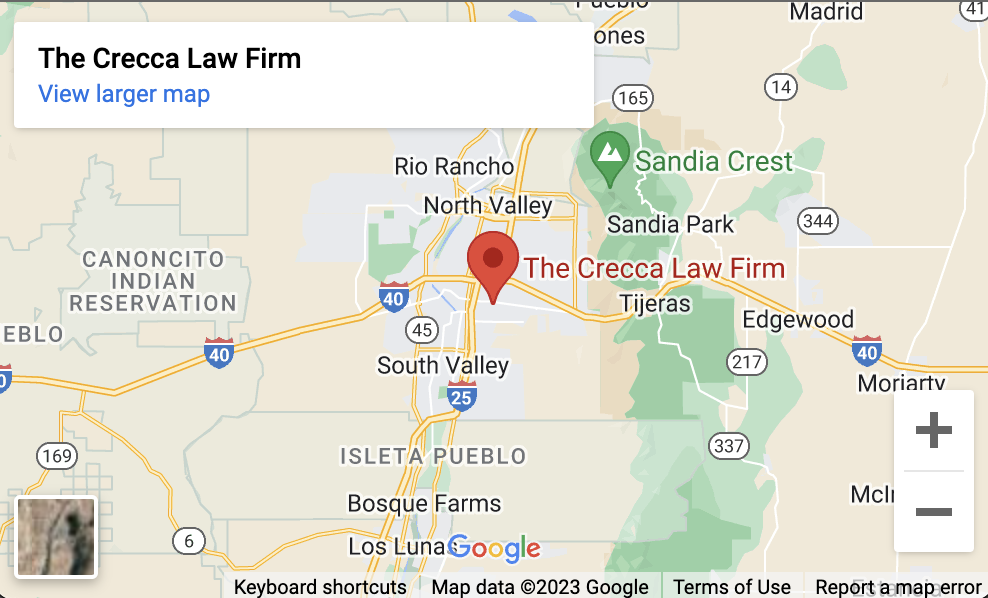
    The Crecca Law Firm is located in Albuquerque and represents clients and takes injury claim cases throughout the entire state of New Mexico.
    The information on this Law Firm website is for general information purposes only. Nothing on this or associated pages, documents, comments, answers, emails, or other communications should be taken as legal advice for any individual case or situation. This information on this website is not intended to create, and receipt or viewing of this information does not constitute, an attorney-client relationship.
    Copyright 2023 The Crecca Law Firm | All Rights Reserved |
    Legal Marketing Solutions by USAttorneys.com
    • Facebook
    • Areas Served
    • Sitemap
    Scroll to top